Business Process Outsourcing (BPO) is one of the largest employment sectors globally, particularly in India and the Philippines.
In 2025, BPO is no longer just about answering calls. The industry has expanded its roots into IT services, customer support, and even digital transformation. For students and fresh graduates, it remains a reliable career option.
It helps them gain experience while studying, build confidence, and start earning early. This income not only supports their families but also helps them continue their education. At the same time, BPO jobs open doors to professional growth and long-term career opportunities.
While a career in BPO does not require a higher degree, many students choose to work simultaneously alongside their studies. It helps them gain income and experience at the same time. However, the industry still demands strong communication skills and confidence.
Because of this, cracking BPO interviews is not as easy as it once was. In today’s competitive world, candidates must prepare well and clearly understand the BPO industry and the job role for which they are applying to succeed in the interview.
In this article, we are going to discuss the best way to answer the common question “Why do you want to join BPO?” Especially for freshers, the answer to this question may become the turning point of the interview, because it reflects not just their understanding of the industry but also the clarity of their career goals.
For experienced candidates, the question may come in a slightly different form, such as “Why did you choose a career in BPO?” or “What keeps you motivated in this field?”
The way of asking questions may differ for fresher and experienced candidates, but the answer shows whether you see BPO as just another job or as a career path full of growth and opportunities.
A well-prepared answer in an interview can create a strong first impression, while an unprepared one can make the interviewer doubt the candidate’s seriousness. This is why it’s important to prepare the answer in a way that balances honesty, confidence, and awareness of what the BPO sector truly offers.
The question may look simple, but the answer can strongly influence the interviewer’s feedback. It reflects your motivation, awareness, long-term thinking, and how well you align with the industry’s values.
Before we jump into sample answers for BPO interviews, let’s pause for a moment. Many candidates rush to prepare replies without even knowing what BPO really stands for. If you understand the basics first, it becomes much easier to explain why you want to join BPO. Also, when you answer with clarity, you naturally sound more confident in front of the interviewer. Hence, let’s first understand what BPO really is
Understand A to Z about BPO: Definition & Global Market Reach
Definition: What is BPO?
Business Process Outsourcing, or BPO, simply means hiring a specialised service provider(company) to handle certain business tasks. Instead of managing everything in-house, companies outsource work like customer support, HR, finance, or IT services. This approach saves time, reduces costs, and boosts efficiency.
To understand BPO better, take an e-commerce brand as an example. It may partner with a BPO firm such as Concentrix or Teleperformance to run 24/7 call centres. This way, the brand can focus on improving products and ensuring faster delivery, while trained agents from the BPO company handle customer queries around the clock.
Another easy way to understand BPO is through telecom services. Imagine a telecom company that provides mobile and internet connections but doesn’t handle customer calls directly. Instead, it outsources this work to a BPO provider.
The BPO company then manages customer care and support, answering billing questions, fixing service complaints, and giving technical support. Customers call the BPO centre(outsourced by the telecom company), not the telecom company itself.

Examples of some well-known BPO companies with their services:
- Concentrix – provides customer support and tech solutions.
- Teleperformance – global leader in call centres and customer experience.
- Genpact – offers finance, accounting, and IT related outsourcing.
- Wipro, Infosys, TCS (India) – handle IT services, provide back-office support and operation services, and customer support for global clients.
Types of BPO Services
BPO is not one-size-fits-all. It comes in different forms:
- Back Office Outsourcing → Finance, accounting, data entry, payroll.
- Front Office Outsourcing → Customer service, technical support, sales.
- Knowledge Process Outsourcing (KPO) → Market research, analytics, legal services.
- Information Technology Outsourcing (ITO) → Software development, IT help desk.
Why Companies Choose BPO
Outsourcing helps companies stay competitive. Key benefits include:
- Saves operational costs.
- Access to skilled professionals worldwide.
- Focus on core business functions.
- 24/7 customer support becomes hectic.
Global Market Reach of BPO
The BPO industry is truly global. The United States, the UK, and Europe are the biggest clients for most of the BPO companies. India and the Philippines are leading outsourcing destinations.
The BPO industry is already a multi-billion-dollar market, and it continues to expand every year. This steady growth proves just how valuable outsourcing has become for modern businesses.
Globally, BPO has become a powerhouse industry. It is already worth more than $250 billion. Moreover, experts anticipate that it will reach nearly $400 billion by 2030.
At the same time, India stands at the center of this growth. The country employs over 4.5 million people in this sector, making it a global leader in this field.
Future of BPO
The BPO industry is changing faster than ever. New technologies, global work trends, and customer expectations are shaping its future in powerful ways.
First, AI and automation are making processes more efficient. Tasks like answering basic queries, processing data, or routing calls are now done much faster with the help of smart tools.
Second, remote work has opened the door to global talent. Companies no longer need to limit themselves to one city or even one country. They can now hire skilled professionals from anywhere in the world, making operations smoother and more cost-effective.
Third, upskilling is transforming the workforce. Instead of handling only simple calls, today’s BPO professionals are moving into advanced roles. Many are now working in areas like analytics, digital marketing, and AI-powered customer support. This shift creates more value for both employees and clients.
Of course, there is a common fear: Will AI replace BPO jobs? The answer is no. While AI can handle repetitive tasks, it cannot replace the human touch that customers expect. People still want empathy, problem-solving, and trust—qualities only humans can provide. In reality, AI will work alongside humans, making their jobs easier and more meaningful.
In short, the future of BPO is not about machines replacing people, but about technology and humans working together. This combination promises better efficiency, smarter solutions, and a stronger customer experience.
Why Interviewers Ask: “Why Do You Want to Join BPO?”
At first, this question may sound casual. But in reality, it is a strategic one. Interviewers ask it to understand your true motivation and to check if you are the right fit for the role.
When interviewers ask “Why do you want to join BPO?”, they’re not just looking for a memorized answer. They really want to see how serious you are about this career and whether you’ve thought it through.
First of all, your motivation matters. Are you genuinely interested in building a career here, or are you simply applying because there are no other options? If you can show that you truly see BPO as a long-term opportunity, this kind of answer feels genuine and leaves a positive impression
Moreover, understanding the nature of the job is very important. Working in BPO comes with unique challenges like handling customers across different cultures and time zones—but it also opens doors to global exposure and rapid career growth. Showing that you’re aware of both sides tells the interviewer you’re prepared, not just curious.
Another thing is your skills and strengths. Employers want to know if you bring qualities such as communication, problem-solving, and adaptability. These are the building blocks of success in this industry. When you connect your own skills to the role, your answer feels more authentic and credible.
But perhaps most importantly, companies look for stability. BPOs often face high attrition because many people treat it as a stop-gap job. If you can convince them that you see a long-term path—whether it’s moving into team leadership, quality analysis, or even HR—it reassures them that you’re here to stay.
Finally, the way you present yourself plays a huge role. Your tone, choice of words, and confidence all reflect professionalism. Think of it this way: the interview starts the moment you answer this question, and how you structure your response can set the tone for the rest of the conversation.
In short: the interviewer is testing whether you’re serious, prepared, and aligned with the BPO industry. A thoughtful answer—backed by real motivation, awareness, skills, and professionalism—can make all the difference.
Best Points to Add in Your Answer: Pros of Working in BPO
Here are some solid reasons you can mention. Choose the ones that fit your situation best.
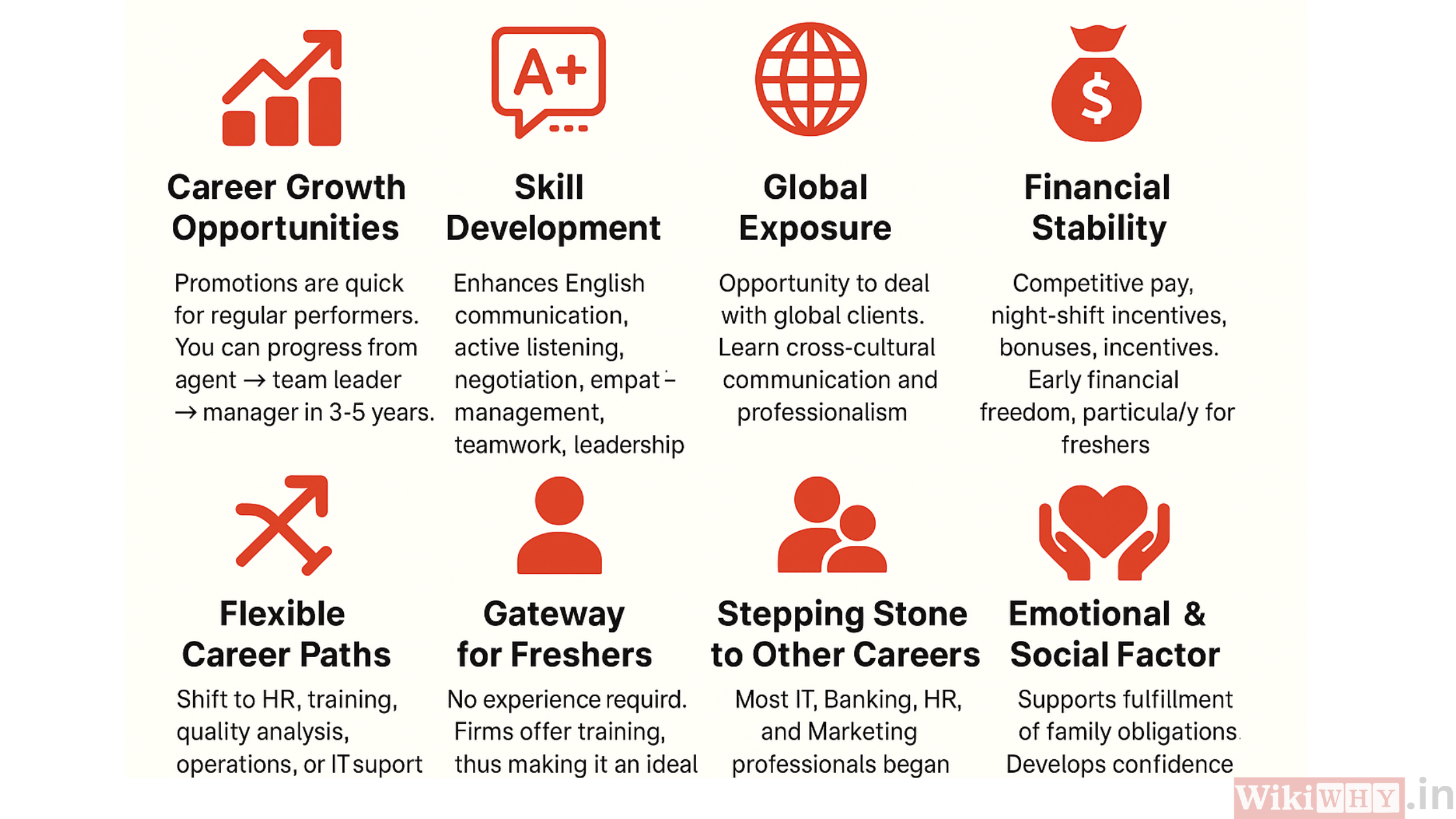
When you answer this question, the key is to sound genuine and professional. You don’t need to cover every reason. Instead, pick two or three that fit your situation best. Here are some strong points you can include:
Career Growth Opportunities
BPO jobs offer quick promotions for consistent performers. You can start as an agent and, within a few years, move into leadership roles such as team leader or manager. This clear growth path makes the industry attractive for ambitious professionals.
Skill Development
The industry helps you build essential skills like communication, active listening, problem-solving, and teamwork. These abilities are useful not only in BPO but also in any future career.
Global Exposure
Working in BPO often means interacting with international clients. This gives you valuable cross-cultural experience and sharpens your professional communication.
Financial Stability
Competitive pay, performance incentives, and bonuses make BPO a stable career choice. For freshers especially, it offers financial independence at an early stage.
Flexible Career Paths
BPO is not a dead end. You can shift into HR, training, quality, operations, or even IT support as you grow. This flexibility adds long-term value to your career.
Gateway for Freshers
Even if you have no prior work experience, BPO firms are open to hiring and training fresh talent. This makes it a strong starting point for your professional journey.
Stepping Stone to Other Careers
Experience in BPO is valued across industries like IT, banking, HR, and marketing. Many professionals begin in BPO and later transition into other roles with ease.
Emotional and Social Factor
A BPO career can also support personal responsibilities by providing financial security. At the same time, it builds confidence, empathy, and resilience.
Real-Life Examples & Success Stories
- Indra Nooyi (ex-CEO of PepsiCo) → began in customer facing roles before advancing to leadership.
- Amitabh Chaudhry (Axis Bank CEO) → was involved in call center operations at the initial stages of his career.
- Thousands of Indians → used BPO to fund education, move abroad, or switch to IT, HR, and corporate careers.
Cons of Working in BPO
- Odd Working Hours –Due to expansion to global clients, Night shifts and rotational shifts can disturb sleep and social life.
- High Pressure – Meeting targets and handling tough customers daily can feel stressful.
- Health Challenges – Long sitting hours, irregular meals, and lack of sleep may affect health if not managed properly.
- Monotony – Repetitive tasks can feel boring after a while unless you keep learning and upgrading your role.
- Job Hopping Risk – Many people treat BPO as a temporary job, so stability may be questioned by employers.
Sample Answers for Freshers & Experienced
Why Do You Want to Join BPO?
Interviewers often ask this question to understand your motivation and long-term vision. Your answer should highlight both your personal growth and professional contribution. Here are deeper examples for freshers and experienced professionals:
| Freshers | Experienced Professionals |
|---|---|
| I want to begin my career in BPO because it gives me the chance to improve my communication and customer-handling skills. I see it as a solid platform where I can learn discipline, professionalism, and gain real-world experience by working with clients across different industries. | I am motivated to join BPO because it allows me to apply my prior work experience while expanding my exposure to global clients. I believe my expertise can add value to the team, and at the same time, the dynamic environment of BPO will push me to keep learning and adapting. |
| For me, BPO is more than just a job — it’s a chance to learn problem-solving and multitasking. I know the role comes with challenges, but I see those challenges as opportunities to become more confident and resilient, which will help me throughout my career. | I want to use my leadership and technical skills in a practical way while guiding teams to achieve better results. The fast-paced nature of BPO will keep me sharp, and it gives me the opportunity to mentor younger employees, which is something I value a lot. |
| I like the fact that the BPO industry offers a clear growth path. Starting as an agent and gradually moving into management roles is motivating for me. I am ready to learn from the ground level and work my way up with consistent effort. | At this stage of my career, I am looking for growth into senior or leadership roles. BPO provides a structured environment where I can contribute strategically while still continuing to develop myself professionally. |
| Another reason is the global exposure. Interacting with international clients will help me improve my English fluency and cross-cultural understanding, which I believe are essential skills in today’s world. | I value the opportunity to work with clients across different countries because it improves cross-cultural communication. This not only makes me a better professional but also adds depth to my experience, preparing me for global roles in the future. |
From the above comparison, you can see how both freshers and experienced professionals can frame their reasons differently. However, during an interview, you don’t have to use all the points at once. Instead, you can pick 2–3 that truly match your personality and turn them into a natural, confident answer.
Here are a few sample answers you can adapt to your own situation:
When you’re a fresher, keep your answer simple, enthusiastic, and growth-oriented.
Sample Answer 1
I want to join BPO because it gives me an excellent platform to begin my career. It will help me to improve my communication and problem-solving skills.
I am excited to gain global exposure by interacting with international clients. I view this as a stepping stone to develop in the corporate sector.
Sample Answer 2
Being a fresher, I view BPO as an arena where I can acquire discipline, teamwork, and flexibility. It provides me with financial independence at an early age.
The fast-track growth options render it a favorable long-term career opportunity for me.
If you are experienced, your response must emphasize skills, leadership, and long-term ambitions.
Sample Answer 1
I would like to work for BPO because I already have very good experience in client management and process handling.
This position offers me the opportunity to train juniors and also perform leadership tasks. I look forward to handling international customers and venturing into higher positions in operations.
Sample Answer 2
My previous experience in customer service has enhanced my negotiation and conflict resolution skills. BPO enables me to utilize these skills at a global level.
I am eagerly anticipating career advancement into quality analysis and management positions.
Things to Avoid in Your Answer(❌)
1. Saying you have no other professional option
This makes it sound like you’re not choosing BPO by interest, but only as a backup plan. Interviewers want genuine and committed employees
2. Looking at BPO as just a short-term job
If you mention that you’ll leave quickly, it signals you’re not serious about building skills or growing in the role.
3. Giving very brief or unprepared responses
One-liners like “I just like customer service” don’t reflect thought or preparation. Always give a clear, well-rounded answer.
4. Focusing only on money or incentives
Salary is important for every employee. However, if your answer revolves only around pay, it shows that you’re not motivated by learning, growth, or long-term interest.
Tips for Answering the Question(✅)
1. Use active voice — keep the energy in your answer.
Instead of “BPO is good for communication skills”, say “I want to join BPO because it will help me improve my communication skills and interact with people from different backgrounds.”
This makes you sound more confident and focused.
2. Show that you did your research.
Before entering the interview room, spend some time reading about the company and the specific process (voice, non-voice, technical, etc.) they are hiring for. If you can mention something like “I noticed your company handles clients from the US, which excites me because I want to gain international exposure,” this shows your eagerness and seriousness for the role.
3. Be realistic and honest.
Avoid over-commitment. For example, I’ll be the best performer within a month” feels fake. Instead, highlight your eagerness to learn. You can mention, “I may be new to this field, but I am confident in my ability to adapt quickly and give consistent results.” Employers value honesty with a positive attitude and not unrealistic commitments
4. Balance professionalism with a human touch.
You don’t need to use heavy jargon(Jargon means using fancy or technical words that ordinary people don’t usually use in daily conversations).
In interviews, jargon can make you sound fake because it doesn’t feel natural. Keep it conversational but also polite. Understand this difference through example.
- ❌ Jargon answer: “I am seeking to leverage my core competencies in client servicing to maximize organizational growth.”
- ✅ Human answer: “I want to join BPO because I enjoy talking to people, solving their problems, and I see this as a chance to grow my communication skills while helping the company.”
End Note
In conclusion, the way you answer ‘Why do you want to join BPO?’ can strongly influence the interviewer’s impression. A good response shows genuine interest in the industry and highlights your readiness to learn new skills. It also reflects your focus on professional growth and financial stability.
Moreover, mentioning global exposure and respect for the profession adds real value. These points prove that you see BPO not just as a job, but as a career with long-term benefits.
Therefore, by answering with clarity and confidence, you leave a lasting positive impact and increase your chances of success. Hence, your answer should reflect these points to have a positive impact on the interviewer
- Your Interest in working in BPO
- Professional development
- Development of skills
- Financial security
- Global awareness
- Emotional respect for the industry
BPO Related Frequently Asked Questions(FAQs) Answered
Q1. Do BPO jobs have any future prospects for freshers?
Yes, absolutely. For freshers, a BPO job is often the first big step into the professional world. It helps you improve communication, client-handling skills, and overall confidence. In addition, most companies offer training programs that prepare you for higher responsibilities. With dedication, many employees move into roles like Team Lead, Quality Analyst, or Operations Manager within a few years, proving that BPO has long-term career prospects.
Q2. What if you have BPO only as a temporary job?
That’s perfectly fine, as long as you explain it positively. You can say that even if your long-term career goal is different, a BPO role gives you valuable skills such as discipline, teamwork, multitasking, and customer interaction. On top of that, it adds credibility to your profile because employers see that you can handle deadlines, deal with clients, and work in a professional setup. So, even if you move on later, the experience will still help you grow in any field you choose.
Q3. Can BPO make an international career?
Certainly. Since most BPOs serve international clients, you naturally develop cross-cultural communication skills and gain global exposure. Many employees use this as a stepping stone to work abroad or transition into multinational companies. For example, a professional who starts in voice support may later move into training or client relationship roles with overseas travel opportunities. In short, BPO can absolutely open doors to an international career.
Q4. Is night shift safe in BPO?
Yes, reputed BPO companies take employee safety very seriously. They provide secure cab transport with GPS tracking, verified drivers, and female security staff when required. In addition, offices usually have biometric entry systems and strict HR guidelines for safety. While night shifts can feel challenging at first, companies put multiple measures in place to ensure employees feel comfortable and protected while working odd hours.
Q5. What skills are most required for BPO interviews?
The most important skills for BPO interviews are clear communication, active listening, patience, adaptability, and problem-solving. Employers also look for confidence and a positive attitude since you’ll be dealing directly with customers. For example, being able to stay calm with an upset client or explain solutions clearly makes a strong impression. On top of that, good computer literacy and teamwork are always an advantage.