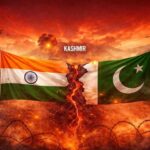
India and Pakistan are rivals mainly because of the 1947 partition of British India, the Kashmir territorial dispute, and several wars fought between the two nations. Political tensions, security concerns, and historical mistrust have continued to shape relations between the two nuclear-armed neighbors.
Relations between India and Pakistan have remained tense for decades. The rivalry between the two neighbors is one of the most well-known geopolitical conflicts in modern history.
From the violent division of the Indian subcontinent in 1947 to wars, border disputes, and diplomatic crises, the relationship between India and Pakistan has been shaped by a complex mix of history, politics, identity, and security concerns.
Understanding why India and Pakistan are often seen as adversaries requires going back to the final years of colonial rule in South Asia and examining the events that led to the creation of Pakistan and the partition of the subcontinent.
This article explores the complete historical background of the India–Pakistan conflict, including the colonial period, the partition of British India, the formation of Pakistan, major wars between the two countries, the Kashmir dispute, and recent developments that continue to influence relations today.
Timeline of India-Pakistan Conflict
- 1947 – Partition of British India
- 1947–48 – First Kashmir War
- 1965 – Second Indo-Pak War
- 1971 – Bangladesh War
- 1998 – Nuclear tests by both countries
- 1999 – Kargil conflict
British India: The Roots of Division
Before independence, most of the Indian subcontinent was under the rule of the British Empire. For nearly two centuries, British colonial administration governed a vast and diverse region that included hundreds of ethnic groups, languages, and religions.
During this period, the population of British India included large communities of Hindus, Muslims, Sikhs, Christians, and other religious groups. While these communities had coexisted for centuries, colonial policies and political developments gradually created divisions that later shaped the demand for separate nations.
The British often used a strategy described by historians as “divide and rule.” Political representation was sometimes organized along religious lines, which strengthened the idea that religious identity should influence political power.
By the early 20th century, two major political organizations began to dominate discussions about independence and the future of the region:
- Indian National Congress
- All-India Muslim League
Both groups initially supported independence from British rule, but they disagreed on how power should be shared in a future independent country.
Rise of the Two-Nation Theory
One of the most important ideas that influenced the eventual division of the subcontinent was the Two-Nation Theory.
This concept argued that Muslims and Hindus in the subcontinent were two distinct nations, with different cultural traditions, historical experiences, and political interests.
The theory was strongly promoted by Muhammad Ali Jinnah, the leader of the Muslim League. Jinnah believed that Muslims in a Hindu-majority independent India might face political marginalization.
As tensions increased during the 1930s and 1940s, the Muslim League began demanding a separate homeland for Muslims.
In contrast, leaders of the Indian National Congress, including Jawaharlal Nehru and Mahatma Gandhi, preferred a unified India where all religious communities could coexist within a single democratic system.
Despite negotiations, the disagreement between these political visions eventually led to the proposal of partition.
The Partition of British India in 1947
One of the most dramatic turning points in South Asian history came in 1947 with the Partition of India.
As Britain prepared to withdraw from the region after World War II, colonial authorities decided to divide the subcontinent into two independent countries:
- India (primarily Hindu-majority)
- Pakistan (envisioned as a Muslim homeland)
The decision was implemented rapidly, and borders were drawn by a British commission led by Sir Cyril Radcliffe. The line separating the new countries became known as the Radcliffe Line.
However, the partition triggered one of the largest and most chaotic migrations in human history.
Millions of people suddenly found themselves on the “wrong” side of the new borders.
- Hindus and Sikhs moved toward India
- Muslims moved toward Pakistan
Estimates suggest that around 14 million people migrated, and communal violence erupted in several regions.
Historians believe that hundreds of thousands of people were killed, and entire communities were displaced during the chaos of partition.
The trauma of these events left deep scars in the collective memory of both nations and remains a significant factor influencing relations today.
Formation of Pakistan
Pakistan officially came into existence on August 14, 1947.
Initially, the country was formed with two geographically separate regions:
- West Pakistan (modern Pakistan)
- East Pakistan (which later became Bangladesh)
The vision of Pakistan was strongly connected to providing a homeland where Muslims could govern themselves and protect their political and cultural identity.
However, the new country faced enormous challenges immediately after independence:
- Refugee crises
- Economic instability
- Political uncertainty
- Border tensions with India
These early struggles contributed to an environment of mistrust between the two nations.
The Kashmir Dispute Begins
One of the most enduring causes of conflict between India and Pakistan is the dispute over Kashmir.
- At the time of partition, Kashmir was a princely state ruled by a Hindu monarch but with a Muslim-majority population.
- The ruler of Kashmir, Maharaja Hari Singh, initially attempted to remain independent. However, conflict soon broke out when armed groups entered the region from Pakistan’s side.
- In response, the Maharaja signed an agreement to join India, prompting Indian troops to enter Kashmir.
- This led to the Indo-Pakistani War of 1947–1948.
- The war ended after intervention by the United Nations, which brokered a ceasefire.
- Kashmir was divided along a ceasefire line, leaving parts under Indian control and parts under Pakistani administration.
- However, both countries continued to claim the entire region.
Have India and Pakistan fought wars?
Since independence, India and Pakistan have fought several wars and military confrontations.
- Indo-Pakistani War of 1965
- The Indo-Pakistani War of 1965 was primarily fought over Kashmir.
- The war involved large-scale tank battles, air combat, and troop deployments along the border.
- After weeks of fighting, international pressure led to a ceasefire.
- Indo-Pakistani War of 1971
- Another major conflict occurred during the Indo-Pakistani War of 1971.
- This war was triggered by political turmoil in East Pakistan. India supported the independence movement there, and the conflict eventually resulted in the creation of a new country: Bangladesh.
- The war significantly changed regional geopolitics.
- Kargil Conflict of 1999
- In 1999, tensions escalated again during the Kargil War.
- Fighting took place in the mountainous Kargil region of Kashmir after infiltrators occupied strategic positions.
- India launched military operations to reclaim the territory, and intense battles followed.
- International pressure eventually pushed Pakistan to withdraw forces.
- The conflict highlighted how fragile the relationship between the two nuclear-armed nations had become.
Nuclear Weapons and Strategic Rivalry
Another factor that increased global concern about the India–Pakistan rivalry was the development of nuclear weapons.
Both countries conducted nuclear tests in 1998, demonstrating their ability to build nuclear arsenals.
This development transformed the rivalry into one of the world’s most closely watched security situations.
Because both countries possess nuclear capabilities, any military confrontation between them draws significant international attention.
Religious and Identity Dimensions
Religion has often played a role in shaping perceptions and political narratives related to the India–Pakistan conflict.
Pakistan was founded with the idea of providing a homeland for Muslims in the subcontinent.
India, on the other hand, adopted a secular constitutional framework, although its population is majority Hindu.
Over the decades, political rhetoric, historical memories, and national identity debates have sometimes reinforced religious divisions between the two societies.
However, many historians also emphasize that political and territorial issues—especially Kashmir—have been more central to the conflict than religion alone.
Diplomatic Efforts and Peace Attempts
Despite repeated tensions, there have also been several attempts to improve relations.
Diplomatic initiatives, peace talks, and cultural exchanges have occasionally reduced tensions.
Examples include:
- bilateral peace agreements
- diplomatic summits
- cross-border bus services between divided regions of Kashmir
However, these efforts have often been disrupted by political crises or security incidents.
Recent Developments and Modern Tensions
In recent decades, relations between India and Pakistan have continued to fluctuate between dialogue and confrontation.
Several issues frequently influence the relationship:
- cross-border tensions along the Line of Control
- terrorism allegations
- political statements by leaders
- military incidents
International organizations and global powers often encourage both sides to maintain dialogue and avoid escalation.
Why the Rivalry Continues
Experts often point to several key reasons why tensions between India and Pakistan persist:
- The unresolved Kashmir dispute
- Historical mistrust dating back to partition
- National security concerns
- Political pressures within both countries
- Regional power competition
Because these issues are deeply rooted in history and national identity, resolving them has proven extremely challenging.
The Future of India–Pakistan Relations
Despite decades of rivalry, many analysts believe that cooperation between India and Pakistan could benefit the entire South Asian region.
Both countries face similar challenges, including economic development, climate issues, and regional security threats.
Improved relations could potentially open opportunities for trade, cultural exchange, and regional stability.
However, meaningful progress will likely require sustained diplomatic engagement and political willingness from leaders on both sides.
Conclusion
The rivalry between India and Pakistan is the result of a complex historical process that began during the final years of British colonial rule.
Events such as the partition of the subcontinent, the creation of Pakistan, the Kashmir dispute, and multiple wars have shaped the relationship between the two nations.
Today, the conflict remains one of the most significant geopolitical issues in South Asia.
Understanding this history provides important context for interpreting current events and recognizing the challenges involved in building long-term peace between the two neighboring countries.
FAQs
The rivalry between India and Pakistan began after the Partition of India, when British India was divided into two independent nations. The partition caused massive migration, violence, and political tensions. Disputes over Kashmir and several wars further deepened hostility between the two countries.
The biggest issue between India and Pakistan is the dispute over Kashmir. Both countries claim the region, and it has been the cause of multiple wars, military tensions, and diplomatic conflicts since 1947.
India and Pakistan were created after the Partition of India. Political disagreements about how power should be shared in an independent country led the All-India Muslim League, led by Muhammad Ali Jinnah, to demand a separate Muslim homeland.
Pakistan claims Kashmir mainly because the region has a Muslim-majority population and shares geographic connections with Pakistan. India maintains that Kashmir legally joined India in 1947 when its ruler signed an accession agreement.
India and Pakistan have fought several major conflicts, including the Indo-Pakistani War of 1947–1948, the Indo-Pakistani War of 1965, the Indo-Pakistani War of 1971, and the Kargil War of 1999. These conflicts have shaped the military and political rivalry between the two nations.
Yes. Both countries became nuclear powers in 1998. India conducted nuclear tests during the Pokhran-II tests, and Pakistan responded with the Chagai-I nuclear tests.
The Kargil War began when infiltrators crossed the Line of Control in the Kargil region of Kashmir and occupied strategic positions. India launched military operations to regain control, leading to intense fighting before international pressure helped end the conflict.
The Line of Control (LoC) is the military boundary that divides Kashmir between areas administered by India and Pakistan. It was established after the Indo-Pakistani War of 1947–1948.
Relations between India and Pakistan remain tense. Border incidents, terrorism accusations, and political disagreements continue to affect diplomatic ties between the two nuclear-armed neighbors.
Some experts believe improved relations are possible through diplomacy, economic cooperation, and regional dialogue. However, resolving disputes such as Kashmir and rebuilding political trust remain major challenges.